You already know this: as a first-time founder, you spend hours crafting your value prop, polishing features, tweaking pricing. But there’s one thing most founders ignore and it’s silently undermining your conversion rates.
That thing is time.
In every offer, there’s an unspoken dimension: how quickly the value delivers, how long the benefit lasts, how urgent the need is. If you don’t surface time in your messaging and terms, prospects interpret your promise as vague. They may intuit “someday, maybe”, and move on.
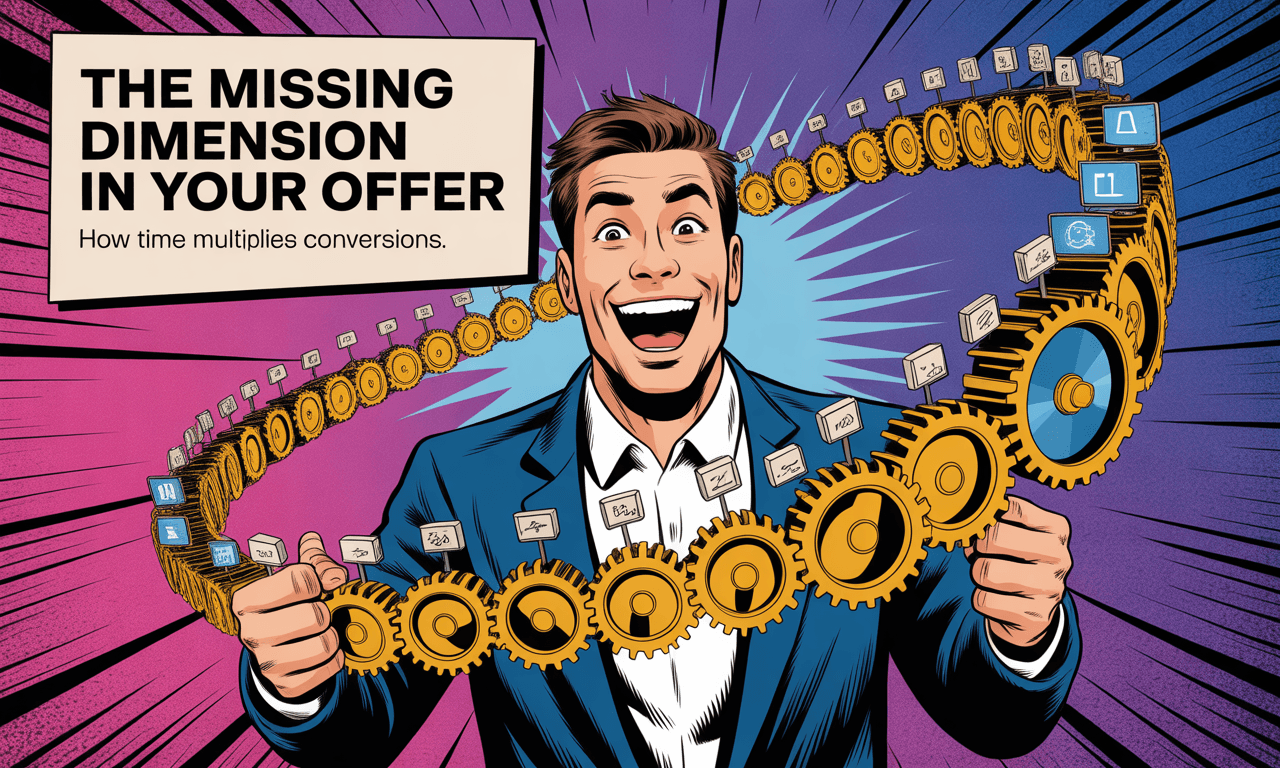
Understanding the Missing Dimension in Your Offer can drastically improve your messaging and help prospects recognize the value sooner.
In this post I’ll show you why time matters, how it’s been used (or ignored) in strong offers, and give you a framework to bake time into your offers so prospects see when the value happens not just what the value is.
Why Time Matters (But Founders Miss It)
1. Time is a built-in scarcity signal
Time is one asset everyone has a limited supply of. When you show the speed or the deadline of your offer, you invoke urgency. That urgency is more credible when tied to real value, not gimmick.
For example, “Get first results in 30 days” beats “Get results”, because the prospect now knows when.
According to recent research in time-value business models, integrating time into your value proposition (i.e. designing a “time-value oriented” business model) increases perceived customer value.
Put simply: in a world where attention is scarce, people value speed, delay, and deadlines more than you think.
2. Without time, “value” is fuzzy
Most beginner offers say “We help you grow 2× in revenue” or “We increase conversions by 30%.” But when? In six months? A year? If that’s not clear, the brain fills the gap: “Oh, maybe eventually… someday.”
That ambiguity reduces trust.
Contrast that with Airbnb’s tagline “Book in 30 seconds” (which implies speed in booking), or tools like Grammarly that promise “Write better, instantly.” These brands lean into the time aspect of their value.
3. Time aligns expectations and reduces “overpromise” gaps
If you commit to “double your MRR” but don’t say over what period, a customer may expect that in 2 weeks and be disappointed. When you anchor the timeframe, you create guardrails.
Also, aligning to time helps your internal roadmap: you know what parts of value you must deliver when (month 1, 2, 3, etc.).
4. Time lets you tier and price more cleanly
You can layer “fast” as a premium version (e.g. express delivery, 7-day jumpstart, VIP track) vs “standard track.” Without time, your plans feel undifferentiated.
Psychological pricing and packaging often use anchoring and decoy strategies, layering speed or immediacy is a powerful differentiator.
DIM Framework: Deliver, Interval, Momentum
Here’s a simple framework (I call it DIM) to bake time into your offers. Use it to audit existing offers or build new ones.
| Component | What it means | Questions to ask / architecture |
|---|---|---|
| Deliver | When does the first meaningful result arrive? | “By week 2 you’ll see X.” “Within 7 days I’ll hand you a roadmap.” |
| Interval | Over what period does the value sustain, compound, or renew? | “We guarantee 12 months of support.” “Your ROI accrues month-by-month over 6 months.” |
| Momentum | How does speed or acceleration vary? | “Fast track upgrade in 14 days.” “Milestones at month 1, 3, 6.” |
You can think of an offer not just as value, but as a time schedule of value.
Here’s what you do when you build an offer:
- Define your fastest credible deliverable. Don’t promise miracles. What’s the earliest meaningful milestone you can reliably hit?
- Lay out cadence & duration. After that first deliverable, how often will you deliver further value (weekly, monthly)? For how long?
- Add optional acceleration layers. For example, a “VIP acceleration” path where the client pays extra to get faster communication, extra sprints, or early access to features.
- Embed deadlines in the offer. Aspiration alone is vague; deadlines anchor urgency. (“Offer expires,” “Enroll by X date to start in June cohort.”)
- Write time into your messaging repeatedly. In your landing pages, sales scripts, and onboarding, always remind “what happens when.”
Examples & Case Snippets
- Onboarding accelerators: Many SaaS companies offer a “first 30-day onboarding” track where by day 30, you have full integration and training. That time boundary makes the transition less nebulous.
- Course launch windows: If you enroll today, get bonus modules delivered weekly for 8 weeks. That tells the student: “Your learning spans 8 weeks,” rather than “take it anytime.”
- Consulting packages: Instead of “We’ll double your growth,” you say “Month 1: audit & quick wins. Month 2: scaling plan. Month 3–6: execution support.” The client sees the map plotted over time.
- Express vs standard tracks: You can have a 90-day “express growth” plan vs a 180-day “steady growth” plan. Both promise growth, but one is speed-weighted and can be priced higher.
I used this approach myself in [Nomad Foundr’s flagship program] we advertised “Launch in 90 days or your money back.” Because that 90 days was built into the promise, it turned into a feature, not a risk. (Yes, we absorbed some cost for the rare refund, but overall it increased conversion by nearly 25%.)
Tactics to experiment with immediately
- Add a “delivery by” promise in your headline or sub-headline.
- Use countdowns or deadline clocks for offers to show “Enroll before X to start by Y.”
- Create an accelerated track for premium clients.
- In sales calls, walk the prospect through a timeline map: “Week 1 we’ll do this, by week 4 you’ll see that…”
- Build a “time-locked bonus” e.g. “If you sign before May 15, you get 3 extra coaching calls in your first month.”
- In pricing tiers, label them as “Standard,” “Fast Track,” “VIP”, the difference is not just feature, but time-to-value.
Objections & Caveats
- “But I can’t guarantee speed.” Don’t overpromise. Use qualifiers: “Up to 30 days,” “Typically delivered in 3–5 weeks,” “Contingent on your inputs.” Always guard credibility.
- “Some value accrues slowly.” True. In such cases, surface both immediate and long-term value. E.g., “In first 2 weeks you’ll see X, over 6 months you’ll see Y.”
- “Time pressure seems manipulative.” If your core value is real and your timeline is credible, it’s persuasive, not manipulative. The distinction is sincerity.
- “Clients differ in speed.” You can calibrate. Use the fast path only for those committed; let others go at their own pace but price accordingly.
How to audit your existing offers (quick checklist)
- Does your headline or subheadline mention timing (days, weeks, months)?
- In your sales page / one-pager, is there a timeline / “what happens when” section?
- Are your pricing tiers differentiated by speed or delivery cadence, not just features?
- Do you offer an accelerated or VIP path?
- Are there clear deadlines or enrollment windows to trigger urgency?
If more than two are missing, your offers are underleveraging time.
Conclusion + Invitation
Time is the silent dimension in your offers. Most founders treat value as static; few layer timing into their messaging. But when you do, you turn vague promises into promised delivery schedules. That’s how you build trust and urgency.
Go audit your top 3 offers right now using the DIM framework. Add timing, slow or fast tracks, deadlines.
If you’d like me to personally review your offers (landing page, pitch, pricing) and suggest where time can be injected, I’m happy to help, just ping me with links or drafts.
Let’s make your offers sharper, more compelling, and time-anchored.