You’re doing the wrong thing first
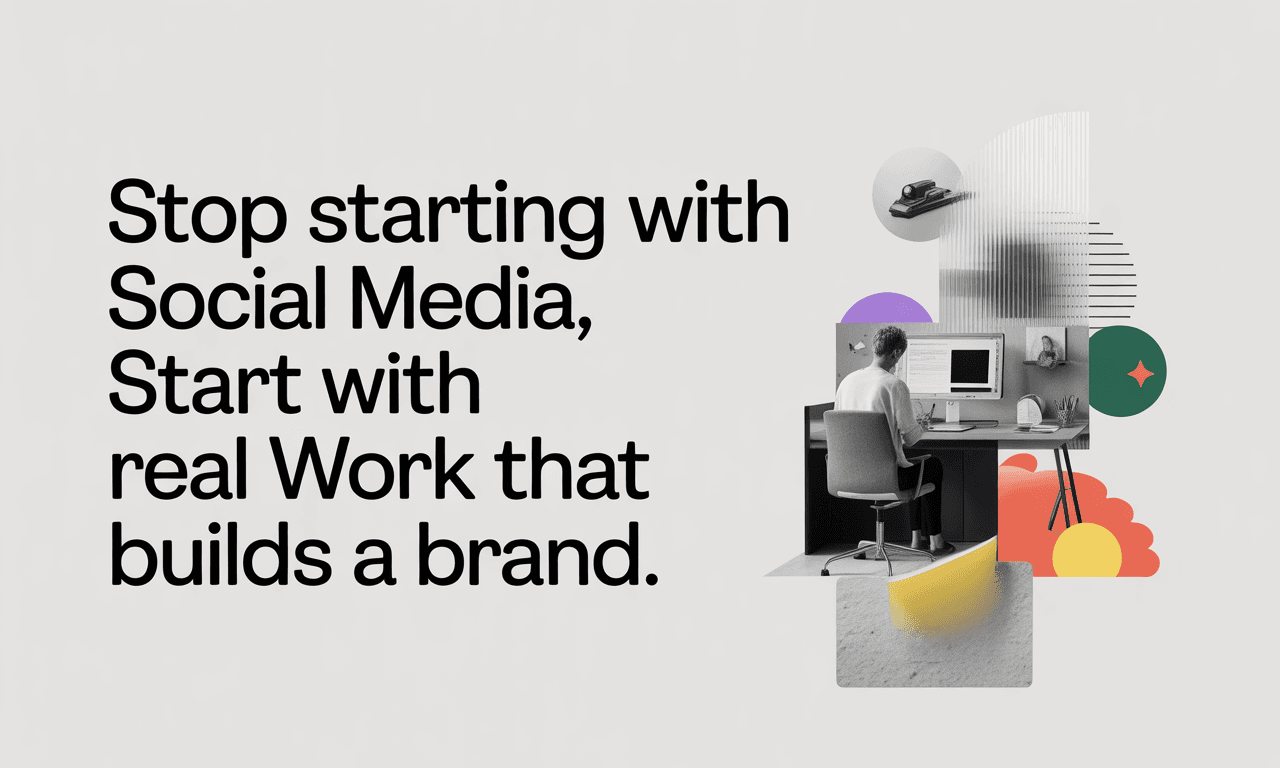
Look, I’ve seen it too many times: highly motivated first-time founders spending hours fine-tuning their Instagram grids, designing the perfect “Meet the Founder” post, counting likes, refreshing analytics dashboards, and yet they’re still struggling to land that first paid customer. I get it. You feel you should be “doing social” because everyone says you must, but you’re stuck in the wrong end of the problem.
Here’s the truth: social media is a symptom, not the strategy. You build something worth talking about first. When your ideas spread, when your product gets traction, when your organization has built a “social ratchet” that works, then social media becomes a consequence. If you do it the other way round, spending all your time grooming your social, obsessing over posts, hyping tweets, nothing much changes.
Let’s dig into why this inversion sabotages first-time founders, what you should build before your social presence, and exactly how to execute that sequence. I’m writing this as your fellow founder, because at Nomad Foundr we work with founders who launch and scale, and I’ve seen this mistake over and over. Let’s avoid it.
1. Why “social first” is seductive, and wrong
The allure of social media is obvious: it’s visible, it’s measurable, it’s immediate. A post gets likes, comments, feels satisfying, and you feel you’re “doing” marketing. But the problem is: that feeling easily replaces actual leverage.
a) Icon vs influencer
Take the famous analogy: the Mona Lisa is everywhere online. She has massive social presence, even though she never tweeted, never made a story. She’s big on social because she is iconic. She didn’t become iconic because of social.
Your goal should be: build something iconic. Then social becomes the amplifier.
b) If you’re chasing likes, you’ll miss value
Research shows that brands that have huge followings or engagement don’t always have bigger social teams. The presence comes from substance. A 2019 study of 3,380 brand Twitter accounts found that having high “centrality” or network influence helped with engagement, but follower count didn’t necessarily grow just from interactions.
In other words: it’s not how many posts you make, it’s whether you have something worth engaging with.
c) Social is a channel not a strategy
According to a survey by Sprout Social, 65% of consumers felt more connected to brands that already had a robust presence, and 70% felt more connected when a brand’s CEO was active online.
But the report itself emphasizes: “connection is the new currency” and social media is just the surface of that.
So if you start at social, you risk putting the cart before the horse.
2. What to build before you post deeply
Instead of starting by crafting 50 social posts, here’s what you should focus on first (in this order):
A. Offer ? Value ? Remarkable
- Define your offer: What is your product, course, or service? Who is it for? What transformation does it deliver?
- Validate the value: Have you talked to real users, found willing first-customers, confirmed they would pay?
- Build something remarkable: One founder of a SaaS company discovered that by simply reducing onboarding time from 10 to 2 minutes, referrals doubled. The result? More organic mentions without extra posts.
B. Narrative & Positioning
You need a story worth telling. Not “we are a course company”, but “we help first-time founders go from idea ? $100K ARR while other programs ignore you”. That positioning makes you distinct.
And when your audience finds value, they’ll talk about you, not because you posted more, but because what you did mattered.
C. Distribution Engine (the ratchet)
- One-to-many: Your blog posts, webinars, course modules.
- Many-to?many: Your alumni, your community of feedback-seekers, your peer network.
- Referral loops: “Alums bring other founders”, “customers become advocates”. When this ratchet works, social becomes a by-product.
D. Systemize, not just hype
Rather than posting new Insta content every week hoping for virality, build a system:
- Weekly “win” stories from members
- A monthly live Q&A
- A community channel where users share their progress These build relationships, credibility, and organic social momentum.
3. Framework: The “Build-Then-Broadcast” Toolkit
Here’s a simple founder-friendly framework you can plug into:
Phase 1: Build
- Customer Interviews: Talk to 20 target-users, ask their top pain, what they tried, how much they’d pay.
- Minimal Launch Offer: Create a simpler version of your product/service, sell it to your first 5-10 customers.
- Gather testimonials & results: Capture real metrics (“went from $0 ? $5K/month”) and genuine words.
Phase 2: Systemize
- Create a referral process: Offer rewards for anyone who brings a friend into your offer.
- Build a community channel: Telegram/Slack/Fb group where users engage, ask questions, support each other.
- Content publishing: Publish one high-value blog or video each week, with “help founders” focus.
Phase 3: Broadcast
- Publish social proof: Share real testimonials, user stories, stats.
- CEO-level voice: You (founder) share insights, failures, lessons, authentic voice matters.
- Leverage existing network: Ask module members, past customers, partner brands to share, this is organic amplification.
- Then schedule posts, build a social calendar after you’ve validated and have substance.
4. Real-World Example: The Social-Powered Without Starting At Social
Let’s look at a practical example: A product coaching company (not name dropping) spent the first six months NOT doing Instagram. Instead they focused on delivering deep value via 1-to-1 clients, collected case studies of clients scaling from $0 ? $50K ARR. Once they had 10 of those, they asked clients to film short thumbs-up videos, posted them on LinkedIn and Twitter, then launched a simple Instagram account. Their follower count grew quickly because the result created the story, they weren’t chasing likes first.
Another example: A B2B SaaS brand built a community forum, gave early users free access, curated user-generated help threads, then the users themselves tweeted their wins, and the brand’s social presence “just happened”. They didn’t have a 10-person social team; they had a product worth talking about.
5. What founders should stop doing right now
- Stop obsessing over which social platform to pick (“Should I be on TikTok, Insta, X, LinkedIn?”). Pick one, pick a reason, and shift focus to value.
- Stop chasing follower count. If you have 10k followers but zero sales or zero engaged community, you’re fooling yourself.
- Stop posting without purpose. Every post must tie back to your offer, your story, your community, not just be “cute content”.
- Stop treating social as marketing start point. It’s an amplifier of your strategic work, not the strategic work itself.
6. Actionable checklist (for this week)
- Monday: List your top 3 founder pain-points you solve. Interview 3 prospects and ask them what they truly struggle with.
- Wednesday: Draft your positioning sentence. Example: “We help first-time founders build a business that reaches $100K ARR in 12 months when all other programs leave you behind.”
- Friday: Identify one testimonial or case you can capture, even if it’s a promise from your first beta client.
- Sunday: Plan one content asset that shares a result or lesson (not a sales post). Publish it on your blog or LinkedIn, and ask your network to share. Then for the next 30 days: focus on value, community, results. Then gradually layer social broadcasting.
Conclusion: Earn the megaphone before using it
As the founder of Nomad Foundr, I believe first-time founders often invert the order: they pick the megaphone first and expect the audience. It doesn’t work. The megaphone is not your strategy, it’s your amplification. Build the substance. Prove the value. Activate the network. Then social will serve you. And when it does, it’ll amplify a brand worth standing behind, not just another noise in the feed.
If you take one thing away: Start with the work, not the hype. Do that well, and your social media presence will be the effect of your success, not the cause.
Call to action: If you’re building your first business and stuck in “social mode”, pause. Clear a weekend. Map out your offer, talk to real users, capture one testimonial. Then come back to social, and you’ll be using the megaphone with something worth amplifying.
Until next time, build first, broadcast second.
Whenever you’re ready, here are 3 ways I & Nomad Foundr can help you:
1. Join The Newbie Founder Newsletter: A weekly 5-minute read to help you break through mental blocks, blind spots, and skill gaps. Plus every month you’ll also get a new hands-on email mini-course to grow your business and audience, delivered straight to your inbox.
2. The Nomad Foundr Resources Vault: Access thousands of curated tools, templates, blueprints, mini-courses, and services designed to save you months of trial and error. Get the All-Access Pass to unlock the entire vault to accelerate your journey.
3. Join the First-Time Founders Program: Our 90-day flagship course with 3,000+ founders. Get the frameworks, skills, and hands-on guidance to turn your knowledge into a real business. Step by step, you’ll ideate, validate, build, launch, and land your first 1,000 customers. By the end, you’ll have launched your business and started growing your audience.