You know that feeling: you’re running full throttle, juggling clients, deadlines, revisions, and chaos, and yet, your revenue barely budges. You catch yourself thinking: If only I had one more client, or if I just charged 20% more, or cut a few corners… But the key to unlocking your potential lies in Service Productization.
But here’s the brutal truth: that path is a treadmill. The more you take on, the heavier it gets. Burnout is waiting, and breakthrough is nowhere near.
One of the most powerful questions any founder (especially in a service-based business) needs to ask is:
How do I make more money without working more hours?
Because if your growth is tied to your individual effort, you don’t have a business, you have a job.
In this post, I’ll show you a better path, one I’ve walked myself. You’ll learn how to move from custom-to-the-bone work toward scalable, repeatable, high-leverage systems through Service Productization. And yes, you’ll retain your sanity.
The Trap: “Custom Everything” Kills You
Let me draw the picture:
- Every project is built from scratch.
- Every client demands a bespoke solution.
- You personally do or approve every deliverable.
- You’re in every meeting, writing every line, tweaking every detail.
This feels “premium.” Many founders believe this is what sets them apart. But in reality:
- You never get economies of scale. You reinvent the wheel each time.
- Timelines become unpredictable. Unique work always takes more time.
- You become the bottleneck. Your business stops when you sleep.
- Pricing pressure creeps in. Clients see templated competitors and ask “Why is this so expensive?”
I’ve been here. For my first 15 speaking engagements, every talk was custom, slide by slide, story by story. That felt like craftsmanship. But over time I realized: it’s a model that doesn’t scale.
The solution? Stop letting every client demand a blank sheet. Start making choices about what moves the needle and what becomes your baseline.
Strategy #1: Productize Your Service (Do Less, Charge More)
What if, instead of reinventing the wheel every time, you sold a few well-designed service packages that cover ~80% of client needs? The “exceptions” become tiny in your portfolio.
Why productization works (and is proven)
- Predictable scope and pricing.
- Lower sales friction, clients see what they’re buying.
- Better margins (you can decide what to automate or delegate).
- Labs for iteration, you improve versions incrementally, not from scratch each time.
Many Requests calls it “selling standard services with fixed deliverables and pricing.”
Copilot’s guide to productizing shows this reduces scope creep and increases predictability.
And Consulting Success shows how the smart consultants use productization to build predictable revenue before layering custom work on top.
“Productized services rule because they hit all of the entrepreneur buzzwords: trainable, repeatable, profitable, scalable.” Greg Isenberg latecheckout.substack.com
How I did it (and how you can)
For me: I reduced my “talks” to 5 core options. One became my Superfans keynote, which is now evolving into a book.
Let’s take a concrete example: wedding videography (but you can map this to your own service).
- Essential Package – Ceremony + highlights (?15 hours work)
- Premium Package – Full-day coverage + same-day edit (?25h)
- Luxury Package – Multi-day, cinematic storytelling (40+h)
In practice, 70% of clients picked Essential or Premium (which follow templated workflows), and only 30% needed full custom luxury. The latter we price at a premium.
Your productization exercise (your week’s assignment):
- Review your last 10 projects. What 3 items or deliverables repeat across 80% of them?
- Choose 2–3 “packages” you can offer. Decide what’s “in” and “out.”
- Create a spec sheet for each: deliverables, timeline, cost, and limits.
- Use these as standard options when selling. Custom work becomes the exception.
Strategy #2: Expand Your Service Ecosystem (Let Current Clients Pay More)
Getting a new client is the hardest step. The easier, and smarter, route is to make your existing clients spend more (without feeling pressured). This is the art of upsell, cross-sell, and ecosystem building.
Examples of ecosystem expansion
Back with the videographer example:
- Offer photography services (you retain a referral cut or partner commission).
- Add a DJ or sound service.
- Include a floral design or décor upsell.
If your base client was going to spend $3,000, this ecosystem pushes them to $4,500, with minimal extra work from you.
Upselling and cross-selling: the formula
Upselling = move a client to a higher package.
Cross-selling = sell complementary services.
Best practices:
- Know the moment: you upsell when the client is already seeing results or hitting limits. In SaaS, successful companies generate 20–40% of revenue from expansion upsells.
- Educate and show value: Don’t just pitch extras. Show what problems they solve.
- Segment your clients: Some are ready for upsells; others aren’t. Don’t push the same offer to everyone.
In short: your next growth lever is not chasing more logos, it’s capturing more value within your current relationships.
The Systems Backbone: Free Yourself From Being the Bottleneck
Before productization or an ecosystem expansion has any chance of working, you’ve got to free your time. That means:
- Document everything. Every process, every checklist. If you haven’t turned something you do often into a template or SOP, do it now.
- Automate what you can. Use tools for proposals, contracts, payments, communications.
- Delegate intentionally. Start with admin (invoicing, scheduling) ? then move to delivery (editing, execution).
- Measure, iterate, improve. Track which tasks are bottlenecks or killing your margins; then optimize.
Back to the videography example: hire an editor at $20/hr to do the Essential Package. You recover 15 hours per job. Use that time to sell more Premium deals or systemize your workflow.
In effect: you build leverage.
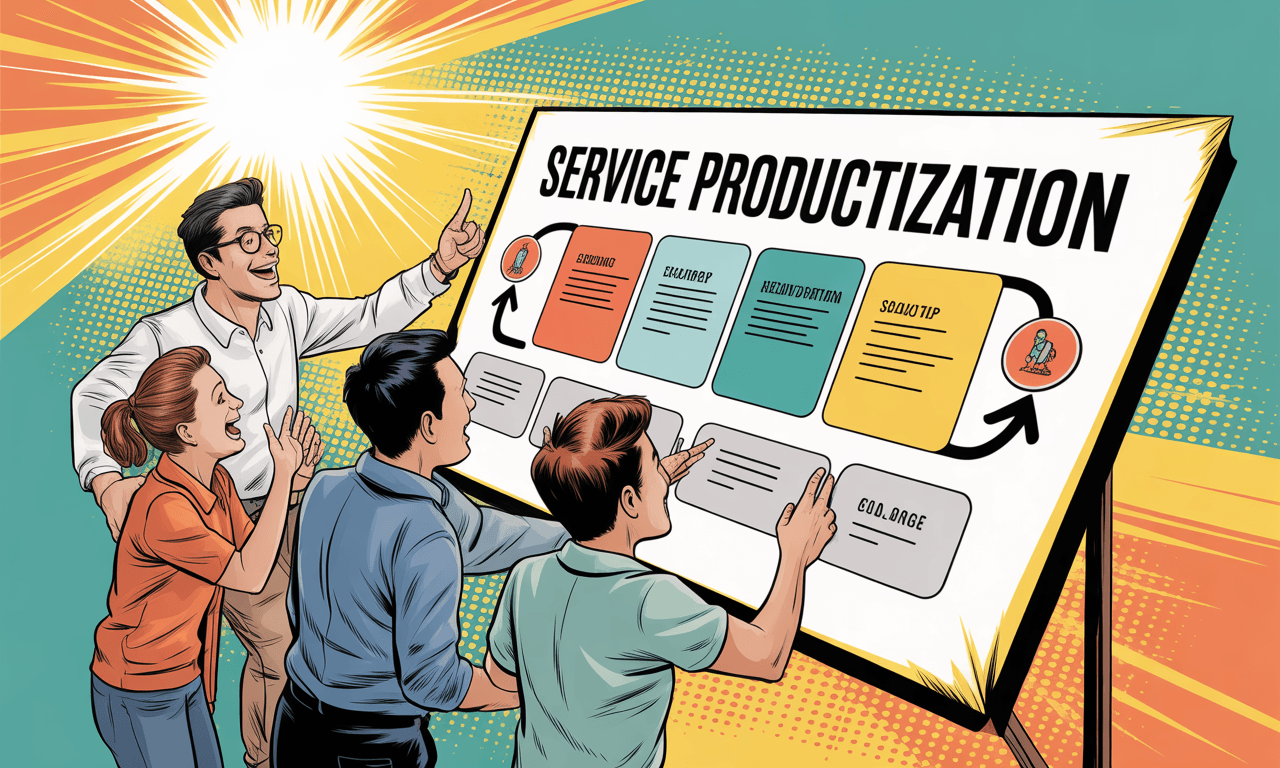
The “Service Scaling” Framework (Your Blueprint)
Here’s a simple 4-step framework you can use:
| Step | Focus | Action | Goal |
|---|---|---|---|
| 1 | Audit | Analyze last 10 projects for repeated elements | Identify productization opportunities |
| 2 | Package | Build 2–3 fixed packages with clear scopes | Standardize your offers |
| 3 | Expand | Brainstorm 3 cross-sell / upsell / ecosystem play | Build client LTV |
| 4 | Enable | Document, automate, delegate & measure ?s | Remove yourself as bottleneck |
You can cycle this framework quarterly, as you grow, new parts become scalable and so on.
What Changes, What Stays the Same
- You still offer custom work. But it becomes your “white glove” option, not your tail wagging the dog.
- You still listen to clients. But you direct them to options, you don’t build from scratch for every request.
- You don’t become impersonal. Great service, care, and relationship-building are still front and center; you just wrap them in structure.
Final Thoughts + Your Immediate Assignment
If you walk away with one idea, let it be this: your revenue should scale without your effort scaling in lockstep.
Here’s what I want you to do this week:
- Pick one service you’ll productize first.
- Write its spec sheet (deliverables + boundaries + price).
- Choose one upsell or cross-sell bolt-on.
- Document one process you do daily (even if it takes just 5 minutes) and convert it into a template.
Let me ask you: what will you productize first?
Share in the comments below or DM me the one package you’re building.