When I talk to first-time founders, one of the most common confessions I hear is:
“I’ve achieved product-market fit… now I just need to scale.”
That’s a seductive belief. But here’s the hard truth: product-market fit is a foundational but incomplete condition. Too many startups stall or die even after “finding PMF.”
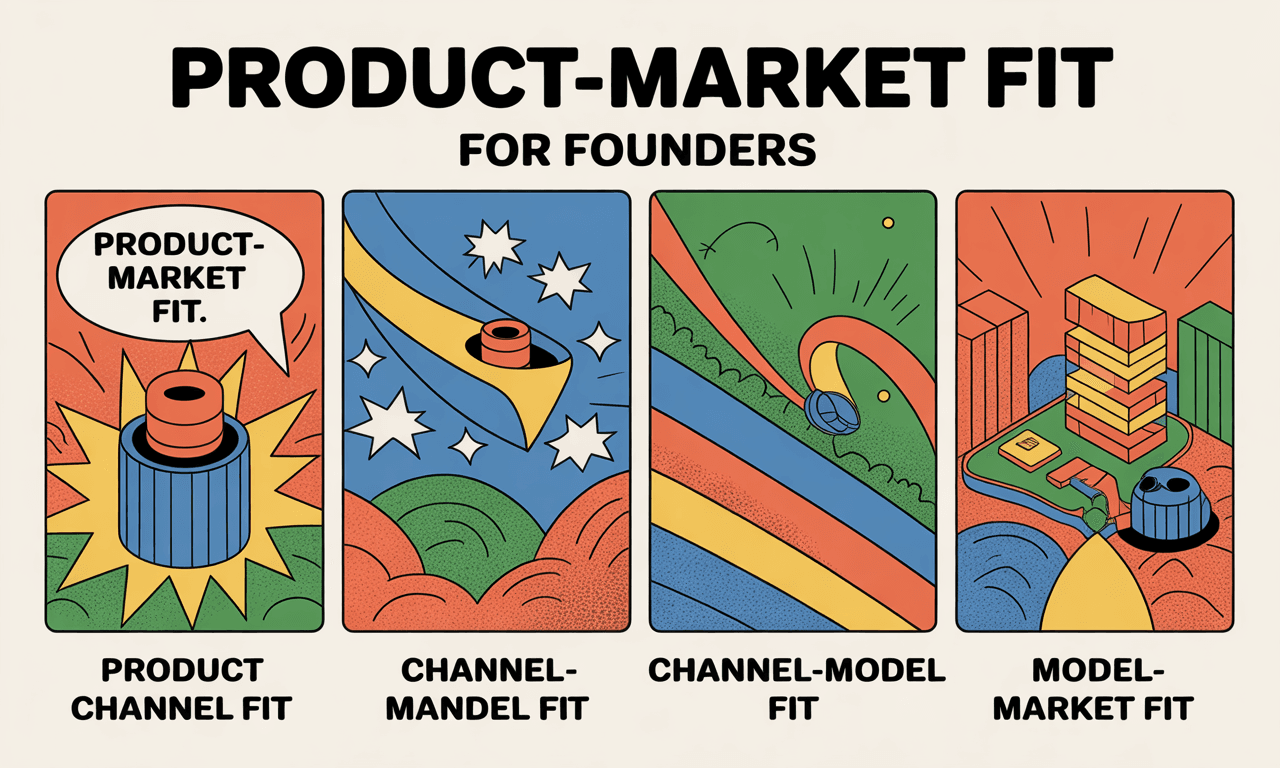
To scale into a true, durable company, you need four fits working in harmony: Market-Product Fit, Product-Channel Fit, Channel-Model Fit, and Model-Market Fit. This is the “Four Fits” framework popularized by Reforge/Brian Balfour.
In this essay I’ll walk you through all four, show you how they interlock, and give you a simple checklist so you can evaluate where your venture is weak (and fix it). Because for first-time founders, your chances of survival depend more on alignment across these dimensions than on heroic work in just one.
The Four Fits: what they mean (and why they matter)
Let’s break them down in your language (i.e. no fluff), then we’ll see how they interact.
1. Market ? Product = Market-Product Fit
Understanding how to scale Beyond Product-Market Fit is crucial for long-term success.
This is the classic “PMF” idea, you build something that a meaningful segment of customers desperately wants (and pays for). Marc Andreessen’s famous line: “Customers are buying the product just as fast as you can make it” still holds.
But here’s the nuance: think market first, product second. Don’t build a solution and then scramble for a problem. Instead:
- Start by deeply diagnosing a specific market (category, who, problems, motivations).
- Then design your product hypothesis (core value, time-to-value, stickiness).
- Iterate rapidly until you get signals: retention plateaus, direct traffic rises, customers evangelize.
Weaknesses here: you may mistake vanity metrics for fit. Or you may find fit but in a market too small to scale. That’s where the other fits help.
2. Product ? Channel = Product-Channel Fit
This is a pivot many miss: products are built to fit channels, channels don’t mold to products.
Imagine you build a long, complex onboarding experience assuming users will discover it via deep sales calls. But you try to scale via TikTok ads. That’s a mismatch. The channel defines the rules (format, audience attention span, friction), and your product must adapt.
What alignment looks like by channel type:
| Channel Type | Product traits that align | Examples / cue |
|---|---|---|
| Virality / network effects | Very short time-to-value, “viral branching factor,” product gets better as more users join | Slack, Dropbox, WhatsApp |
| Paid acquisition | Fast demonstration of value, transactional funnel, targeting-friendly value prop | SaaS with trial ? paid conversion, consumer apps |
| SEO / content / UGC | Product must generate content or contributions; users must have motivation to produce content | Pinterest, TripAdvisor, Quora |
When you nail Product-Channel Fit, 70–80% of your growth often comes from one dominant channel (the “power law of distribution”).
But this fit can break, channels evolve (or die) and you must adapt your product or pivot your go-to-market.
3. Channel ? Model = Channel-Model Fit
Once you have a channel that works, you must ensure your business model (pricing, monetization, margins, CAC/ARPU) works with that channel.
Example: If your product is freemium with a low entry price (say $5–10/month), you can’t expect to scale it via expensive enterprise sales teams. The CAC would kill you. Similarly, if your product is a high-investment B2B platform ($50,000+/year), you can’t lean entirely on cheap social ads or virality.
Channel and model must be synchronized.
Metrics you should examine:
- CAC (Customer Acquisition Cost) vs ARPU (Average Revenue Per User): your acquisition cost must be sustainably lower than what customers pay you.
- Payback period: how long to recover acquisition cost.
- Churn / lifetime value: the model must support retention.
- Scalability constraints (e.g. support costs, onboarding costs) that channel volume might strain.
If Channel-Model fit is weak, growth is leaky or unprofitable.
4. Model ? Market = Model-Market Fit
Finally, your business model (pricing, monetization, packaging) must match how your market prefers to buy and pay for solutions, and that “match” must also support a realistically large outcome (e.g. $100M+).
You can’t force a market to adopt your pricing model. For instance, small businesses may refuse SaaS with annual contracts but accept monthly ones. Big enterprises may accept long contracts but demand dedicated support or customization.
Beyond fit, there’s a “threshold check”:
ARPU × Addressable Customers × Market Penetration ? $100M (or whatever your ambition is).
If your model is solid but your market is too niche (or your pricing too small), you don’t have a scalable business, even if product, channel, and model feel aligned in miniature.
How the Four Fits work together (and why ignoring any one kills you)
These four fits aren’t independent. They’re interlocking gears in a machine:
- A change in your market (e.g. new customer segment) may force you to rework product or channel.
- A new channel emerging (e.g. TikTok, Voice, Web3) might force product pivots.
- A model tweak (e.g. introducing freemium, switching to usage pricing) may break your CAC viability or alienate your market.
- It’s not linear, you can start from any corner and “fit” the rest around it. But all four must align eventually for sustainable scale.
Brian Balfour calls this the difference between a “tugboat” (you constantly push) and a “smooth sailor” (momentum carries you). When your fits align, the wind is behind you.
Another Reforge post spells the risk: you can hit $1M or $10M with decent PMF, but if fits misalign you’ll stall before $100M.
Case in point (HubSpot Sales): Balfour recounts how they laid out market hypotheses first, then built product features, tested retention, and aligned go-to-market channels & pricing in tandem, not sequentially.
Your Four-Fits Health Check: A Simple Diagnostic
Here’s a checklist you can run on your startup right now. Rate each from 0–5 (0 = broke; 5 = rock-solid). The goal is to spot your weakest dimension so you know where to invest.
| Fit | Key questions/metrics | Diagnostic red flags |
|---|---|---|
| Market-Product | Retention curve flattens, direct traffic rises; qualitative feedback strong | You get signups but they churn fast; few referrals; customers say “nice-to-have” |
| Product-Channel | One dominant acquisition channel emerges; product features enable that channel | You’re trying many channels and none scale; product usage doesn’t lend to your chosen channel |
| Channel-Model | CAC ? ARPU, payback period acceptable, margins sustainable | Acquisition costs escalate; churn is high; onboarding costs blow margins |
| Model-Market | Your pricing matches customer willingness; total addressable revenue is big | You hit revenue ceilings; you realize your market won’t accept your proposed pricing or contract terms |
Take your weakest fit, and pick one experiment to improve it. Run short cycles (2–4 weeks) to validate or kill your hypothesis.
A mini-playbook: aligning fits in early stage
Putting this into action, here’s how I’d advise a first-time founder in a seed/Series A stage:
- Define your initial market hypothesis (narrow, specific), skip generic “B2B SaaS.”
- Launch a product MVP to that market. Don’t build full features. Use feedback loops to get retention.
- Pick one channel to test earl: don’t shotgun across 10. Focus all energy there.
- Make small experiments to sync model and channel: e.g. low trial, usage-based pricing, packaging.
- Constantly loop: as you learn, refine market ? product ? channel ? model.
- Periodically run the Four-Fits diagnostic and re-align when any gear starts slipping.
- Watch for channel shifts, model fatigue, or market saturation be ready to pivot.
If you do that, you have a fighting chance of evolving from “I have a product that people use” to “I run a company that can scale to tens or hundreds of millions.”
Why this matters more for first-time founders
- You can’t out-execute misalignment.
- You’ll burn runway trying to fix symptoms (e.g. “we need more marketing”) instead of root causes (a broken fit).
- Early stage is the best time to experiment and fail fast, the cost of refactoring fits is lower now.
- When everything looks like “growth hacking,” this framework gives you architecture instead of tactics.
Let me leave you with this
If there’s one thing I want you to feel after reading this: finding product-market fit is only the beginning. The real climb is orchestrating all four fits, and that’s where companies either stall or take off.
So here’s your action: take one fit from the list above (the one you scored lowest) and block time this week to run a sharp experiment. Two weeks later, re-score. Rinse, iterate.
You’re not alone in this. I build Nomad Foundr to help founders wrestle with exactly these problems. If you want help picking your experiment or interpreting results, ping me. I’ll show up.