Learning is tricky.
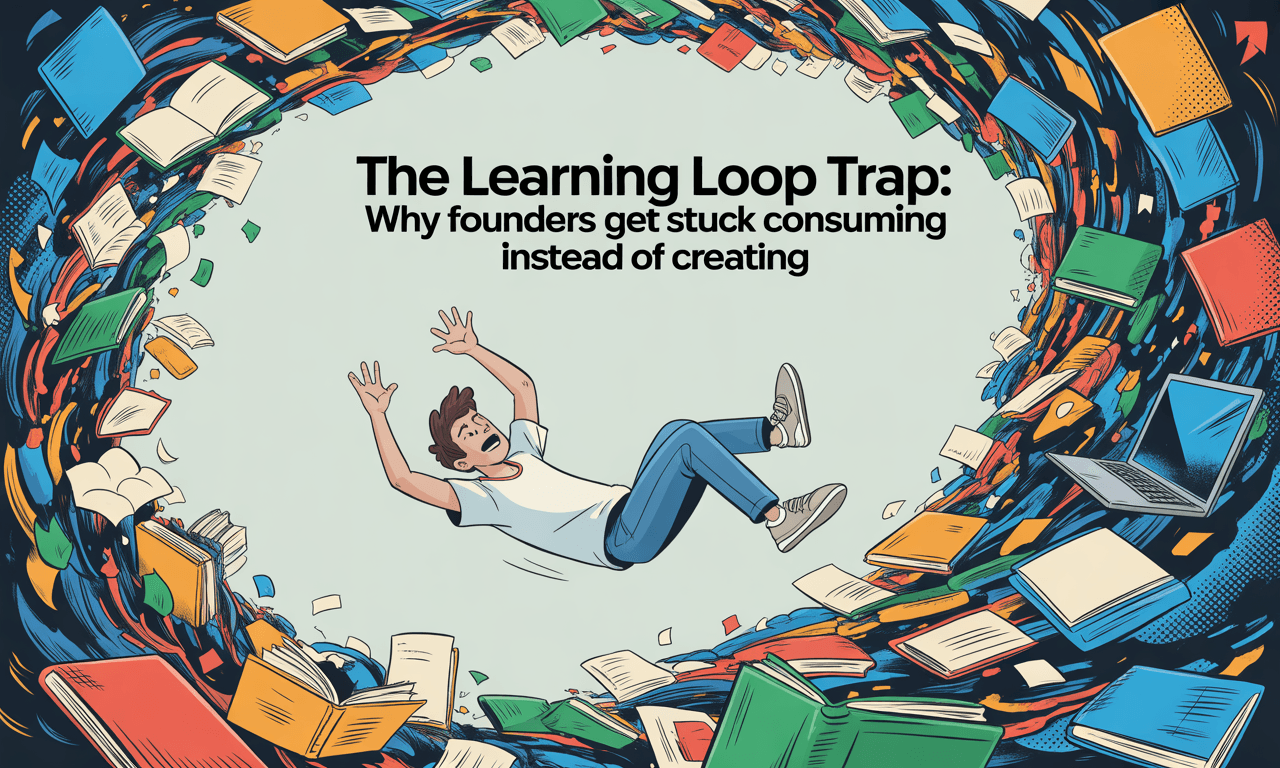
When I read a new book or stumble across a clever thread online, I feel that spark, like I’ve just glimpsed the next big leap. But so often, that spark becomes a trap. Instead of building on it, I reach for another book, another thread, another shiny tactic.
Before I know it, I’ve built a fortress of ideas, and I’m still stuck at the starting line.
If you’re a first-time founder, this is especially dangerous. You can’t afford to let inspiration pile up without execution. You end up with what I call The Learning Loop Trap: perpetual idea accumulation, zero progress.
I’ve fought this loop, and here’s a battle-tested method to beat it. Use it. Adapt it. Don’t let it become another “nice idea” you never apply.
Understanding The Learning Loop Trap is crucial for founders aiming to transform ideas into actionable strategies.
Why the Learning Loop is the Founder’s Hidden Enemy
First, let me name the problem properly: the Learning Loop is procrastination hiding behind intellectual virtue. You read, you absorb, you feel smart, but you don’t act.
“You read all the books, take all the courses … but you don’t take any real actions.” Sam Matla
This is seductive. It gives you “progress dopamine” without risk. You feel like a founder even when you’re doing nothing.
Here’s what keeps you in the loop:
- Perfectionism & uncertainty: You don’t act until everything “makes sense.” But in a startup, clarity rarely precedes motion.
- Novelty hunger: New ideas feel safer and sexier than applying old ones.
- Absent feedback loops: Without strict discipline, experiments dissolve back into noise.
As Chris Argyris’ theory of double-loop learning suggests, the real shift isn’t just in adjusting how we do things. It’s in questioning the way we think about learning and doing.
Breakout Framework: From Spark to Scaleable Patterns
Here’s the core framework I use, the same one I follow when growing Nomad Foundr, and coach other founders to use. It’s built to force you out of consumption mode and into creation mode.
I’ll walk you through three layers:
- Pipe ideas into live workflows
- Run experiments as cycles, not one-offs
- Force reflection with calendar guardrails
Each has a riff and a structure you can adopt immediately.
1. Pipe Ideas Into Live Workflows
You see a hook idea on ? (formerly Twitter). You read a storytelling tip in a blog. Instead of “saving it for later,” you force it into your next content slot.
- If you capture it, you test it, today, or tomorrow.
- If it doesn’t fit any existing task, you let it go (not every idea is precious).
This turns inspiration into forced constraint. It shifts you from collector to doer.
This is analogous to just-in-time learning in education, only take what you need exactly when you need it, not in bulk.
Example: I saw someone using contrarian hooks (“everyone is wrong about X”). Next morning, I repurposed it as a thread. If it flopped, I dropped or tweaked. But I didn’t sit on the idea.
2. Turn Experiments Into Repeatable Cycles
A one-time experiment is noise. What you want is pattern. You want repeatable results.
That’s why I run cycles:
- Two weeks testing different hook types: questions, bold statements, stats, contrarian claims.
- One month posting threads in the morning, the next month in the evening.
- Rotating newsletter subject lines over successive issues.
At the end, you compare: what held up over time? What was an outlier?
This is the same mindset underlying the Build ? Measure ? Learn cycle in lean methodology.
This approach mirrors what’s advocated in mature experimentation cultures: experiments should be hypothesis-driven, repeated, and tied to real metrics.
Tip: Track your experiments in a simple sheet. Every row = one cycle. Columns: hypothesis, date range, variant, metric(s), result, decision (keep, tweak, discard).
3. Bake Reflection into the Calendar
Even your best experiments fade if you don’t look back on them. I guard a 45-minute block every Friday for this.
Here’s what I do:
- Tag top-performing tweet formats to reuse.
- Review newsletter open rates, subject lines, CTAs; mark the baseline.
- Write at least one lesson from a flop: ask why something failed (timing? length? hook?) and hypothesize next steps.
This structured reflection is your anchor. Otherwise, your experiments drift into vagueness.
This aligns with models of learning loops: knowledge ? application ? feedback ? reflection ? next iteration.
Why This Works (And Why Other Approaches Fail)
Here’s the logic behind this framework, so you believe in it, not just apply it blindly.
| Problem in Typical Learning | What My Framework Repairs |
|---|---|
| Ideas accumulate endlessly | You force idea-to-workflow or drop |
| One-off tests can’t validate | Cycles surface signals over noise |
| No time for review | You bake in reflection weekly |
| Feedback delay or absence | You force immediate measurement and learning |
The consequence: you stop being a consumer of ideas. You become a producer of experiments and outcomes.
This mirrors action research models where planning, action, feedback, and re-planning happen in spirals. And you’re not just executing, you’re evolving your assumptions (double-loop learning).
How to Start? Your Week-by-Week Setup Guide
Here’s how a first month looks if you adopt this framework:
Week 1: Setup & Launch
- Build your “experiment tracker” (sheet or Notion).
- Define three idea-to-test slots (e.g. thread, newsletter hook, social post).
- Plan your first cycle: e.g. test four hook types over two weeks.
Week 2: Run & Observe
- Execute the tests.
- Collect baseline metrics (impressions, click-through, opens, engagement).
Week 3: Continue Cycle, Begin Tagging
- Introduce variant(s) or rotate.
- Flag early patterns.
Week 4: Reflection & Reset
- Use your designated 45-minute slot.
- Tag top formats.
- Document lessons.
- Plan next month’s cycles based on what survived.
Do it again next month rinse. Over 3–4 cycles, your intuition sharpens and your “shiny new idea” addiction decreases.
(Optional) Extended Version: Tracking Signals vs. Noise
As you scale, you’ll need to filter signal from noise:
- Avoid vanity metrics (likes, superficial traffic). Focus on metrics tied to your mission: conversions, subscriptions, demos.
- Keep a “memory bank” of what experiments were tried, when, and what happened. Even if you didn’t win, the failure is data.
This is more advanced, but you’ll need it as you grow beyond the learning loop into a culture of experimentation.
Final Word (and the mental shift you must make)
The Learning Loop isn’t a bug, it’s a lure. It tells you you’re “learning” when you’re really delaying. It makes you feel productive when you’re stalling.
The antidote is simple: force ideas into workflows, run experiments as cycles, and force reflection. Over time, you’ll shift from inspiration-chasing to pattern-finding.
You’ll stop being a hoarder of ideas and become an architect of outcomes. If you try this, I’d love to hear how it goes. Drop me a message or reply here with your first set of cycles. Let’s co-evolve.
Whenever you’re ready, here are 3 ways I & Nomad Foundr can help you:
1. Join The Newbie Founder Newsletter: A weekly 5-minute read to help you break through mental blocks, blind spots, and skill gaps. Plus every month you’ll also get a new hands-on email mini-course to grow your business and audience, delivered straight to your inbox.
2. The Nomad Foundr Resources Vault: Access thousands of curated tools, templates, blueprints, mini-courses, and services designed to save you months of trial and error. Get the All-Access Pass to unlock the entire vault to accelerate your journey.
3. Join the First-Time Founders Program: Our 90-day flagship course with 3,000+ founders. Get the frameworks, skills, and hands-on guidance to turn your knowledge into a real business. Step by step, you’ll ideate, validate, build, launch, and land your first 1,000 customers. By the end, you’ll have launched your business and started growing your audience.