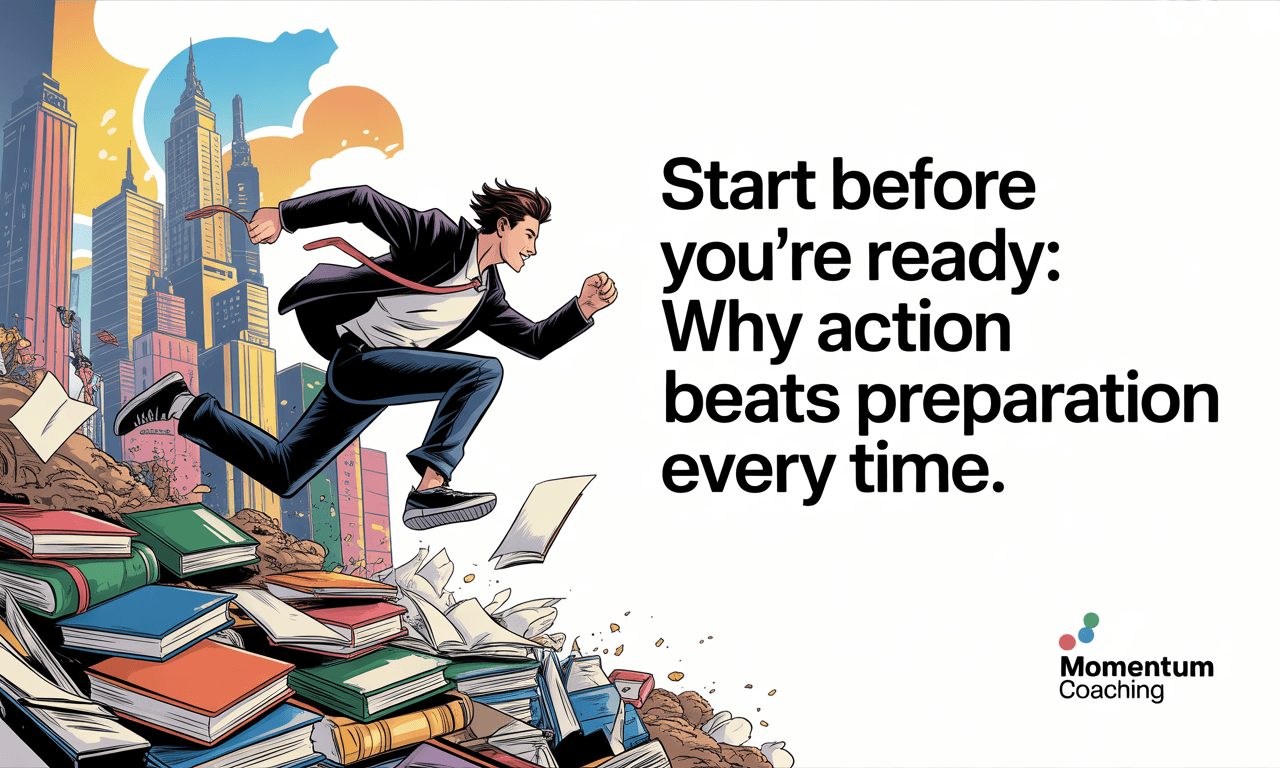
Let me start with a confession: I once spent three months “preparing” to launch my first product. I read books, enrolled in courses, obsessed over spreadsheets, refined my business plan over and over. By the time I “felt ready,” the market had moved. Worse, my own momentum had stalled. This experience taught me an invaluable lesson: to truly succeed, you must Start Before You are Ready.
I tell this not to shame you, but because I bet you’re doing something similar right now. You’ve got a great idea. You’re running numbers, scouting cases, trying to find the “perfect moment.” The fear says: “Don’t launch until you’re sure.” But I’ve learned (over 15 years) that waiting is often the real trap.
This article is for the founder stuck in preparation mode. I’ll walk you through why waiting is costly, how action gives you leverage, and a simple 48-Hour Rule you can use today. Let’s turn that idea into motion.
Understanding that you must Start Before You are Ready is crucial for any founder. It shifts your mindset from perfectionism to action.
Why “Perfect Timing” Is a Myth
There’s no ideal launch window
If you wait for all lights to turn green, market, product, personal confidence, you’ll wait forever. Every founder I admire started before they “felt ready.” Amy Porterfield left her corporate job without a blueprint. Lewis Howes launched a podcast from his sister’s closet with a $100 mic. None waited for perfect alignment.
It’s not magic; it’s that they used what they had and learned forward.
Planning vs. doing: the lean way wins
Research comparing “business planning” and “lean startup” behaviours shows something interesting: writing a full plan correlates weakly with outcomes, but lean practices, talking to customers, collecting pre-orders, pivoting, correlate more strongly with venture performance.
In other words: the sooner you act, the sooner you get feedback, and the better decisions you can make. Waiting for perfect certainty gives you nothing in return.
The planning fallacy lurks
We all fall victim to the planning fallacy, the bias of underestimating how long things take and overestimating how much control we have. So we believe we can plan every variable, and delay until the “ideal” moment. Reality then smacks us: timeline slips, assumptions break, and we’re back to square one.
So yes: build a plan, but don’t let it immobilize you.
The Real Cost of Waiting
You might believe waiting hurts only your nerve. But it has real, measurable costs:
1. Your competition is moving
Every day you delay, someone else is grabbing eyeballs, making calls, testing ads, collecting email leads. Markets evolve, attention shifts, and opportunities (sometimes small ones) vanish.
2. Momentum dies
Ideas feel urgent today. Tomorrow, they feel optional. The longer you delay, the more that initial spark fades into “someday.”
3. You lose learning time
The greatest lessons come in action, not in planning sessions. Each iteration (even the failed ones) reveals assumptions you didn’t know you had.
4. Confidence erodes
You start telling yourself: “I’m not ready.” Each day of inaction reinforces that limiting story. Fear morphs into paralysis.
5. Hidden opportunity cost
Waiting has a cost that’s often invisible: missed market signals, delayed income, deferred hiring, lost positioning. This “cost of inaction” shows up across industries when companies refuse to adapt.
In sum: the cost of doing nothing is rarely zero, and over time, it creeps into everything.
The Action Advantage: What Moves You Forward
Let me reframe: action isn’t just risk mitigation, it’s the force multiplier. Here’s what it gives you.
Action creates clarity
You can’t steer a parked car. Once you move, you see bumps, curves, pivots. Course corrections become useful, not regrets.
Action builds confidence
Every micro-win (first signups, first call, first sale) reminds you you can do it. You rewire your own belief system.
Action attracts opportunities
People want to back doers, not planners. Clients, partners, mentors gravitate toward momentum.
Action gives you leverage
By acting early, you gain positioning, learn customer language, establish feedback loops, and build optionality. Later, you can choose direction from multiple vantage points.
(Look: these are things you can’t build purely from spreadsheets or mind maps.)
The Preparation Trap (and How to Avoid It)
Let’s not demonize planning. It has value. But it becomes a trap when used to avoid risk. Here’s how most of us fall into it:
- We tell ourselves we need more research
- We wait for perfect timing
- We wait for more money
- We demand complete certainty
- We promise ourselves we’ll launch when conditions align
But here’s the hard truth: you will never have full information. You will never feel 100% ready. Conditions will never be perfect.
The difference between founders who succeed and those who don’t is seldom luck, it’s that one group learned to start despite uncertainty. They used fear as a fuel, not as a brake.
The 48-Hour Rule: A Simple Framework to Break Inertia
Here’s a plug-and-play rule I live by. Use it today.
When a new idea or opportunity arises, commit to taking one concrete action within 48 hours.
It doesn’t have to be perfect. It just has to start movement. Examples:
- Write the first paragraph
- Record a rough version of your video
- Send one outreach email
- Make one phone call
- Publish a landing page (even without polish)
That first action is your momentum seed. Once movement begins, you’ll find subsequent steps easier.
To make this bulletproof:
- Decide on the smallest meaningful action Something that’s just big enough to move you forward but small enough to be doable.
- Block a 25-minute window and do it Don’t wait for “later.” Start now.
- Plan the next micro-step Even if you don’t complete it, you stay in motion.
- Iterate and learn Use whatever result you get to inform your next step. Adjust.
This is how the best founders overcome fear, not by eliminating it, but by acting alongside it.
Dealing with Fear (Yes, You’ll Always Feel It)
Let’s be real: fear doesn’t go away. The founders I look up to all say the same, they still feel it. The difference is they’ve learned to dance with it.
Here’s how:
- Name it. Fear of failure. Fear of being judged. Fear of success. Recognize that naming reduces its power.
- Reframe it. Think: “Fear means I’m touching something that matters.” Use it as a signal, not a stop sign.
- Expose it. Break down your fear in writing. What’s the worst that could happen? How likely is it? What would you do if it happened?
- Take micro risks regularly. Each time you act (in the 48-Hour Rule), you desensitize the fear receptors a little.
Over time, the shock of action lowers. You’ll build muscle in uncertainty.
Your Turn: The Action Challenge
As you read this, something is niggling in your mind, a project, a question, a conversation you’ve deferred. Let’s act on it now.
- Pick one thing you’ve been preparing for but not launching.
- Decide the smallest possible first step you can take today (or in the next 48 hours).
- Set a 25-minute timer and do it.
- Schedule your next micro-step for tomorrow or the next day.
- Reflect after completion: what did you learn? What surprised you?
If you’re stuck, drop me a message. Tell me what you picked, and I’ll help you pick the micro-step. Accountability helps.
Remember: The cost of inaction is always higher than the cost of imperfect action.
Why This Matters for You (and for Nomad Foundr)
At Nomad Foundr, my mission is to help first-time founders not just think, but to do. Too many aspiring entrepreneurs get stuck analyzing, preparing, planning, and never launch.
If I stand behind anything in my brand, it’s this: founders succeed by iterating forward, not by waiting for ideal conditions.
So you won’t see me preaching perfection. You’ll see me teaching momentum. You’ll see me nudging you to take that micro-step. Because when you act, anything becomes possible.
Let’s build forward.