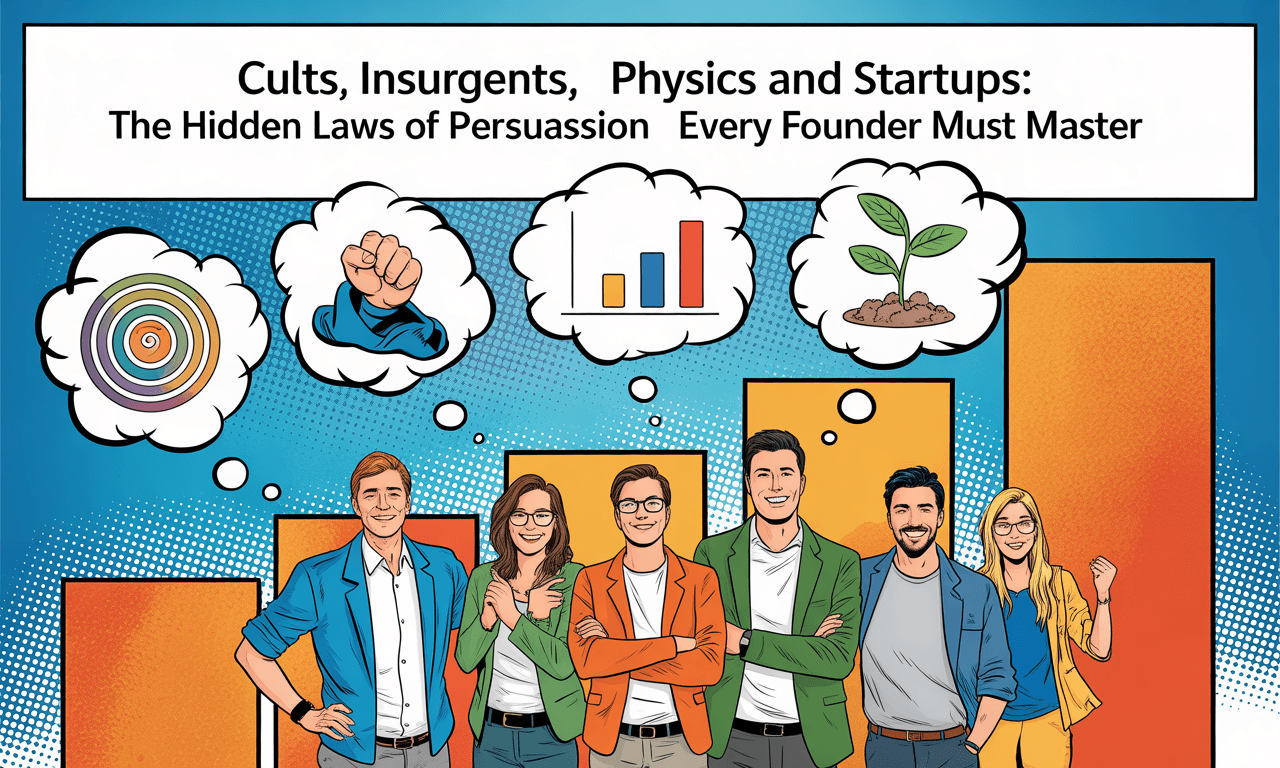
I’ll be blunt: most founders suck at communication. You have a product. You have a vision. You even have half a following. But when it comes to getting people to see your world, commit to your mission, and act with you? You fail. Not because you’re incapable, because you’re using tactics that don’t scale at the level of belief. Understanding The Hidden Laws of Persuasion can be a game changer.
I recently listened to Shane Parrish’s The Knowledge Project podcast with Lulu Cheng Meservey, where she unpacked 20 communication principles drawn from cults, insurgencies, and even physics. Some of them sound wild at first. But as I reflected on them, I realized how directly they apply to the challenges founders face. In this article, I want to translate those raw insights into a playbook you can use immediately, to own your narrative, build trust, and lead an audience that actually wants to follow you.
Why this matters, especially for first-time founders?
Let’s set the stakes. You’re building something early. You don’t yet have brand equity, wide reach, or massive social proof. What you do have is your story, your voice, and your ability to move people one by one. If your communication is weak, unclear, or forgettable, you stall.
These principles align closely with The Hidden Laws of Persuasion, which can enhance your ability to communicate effectively.
Over time, I’ve seen founders with decent ideas sink simply because they couldn’t make people believe. They led with features and spreadsheets. They ignored the emotional, narrative side. They trusted that “logic + stats” would do the work. It doesn’t.
So this is a call: lean into the narrative, the paradoxes, the conviction. Be deliberate. Use these principles to build a brand that doesn’t just sell, it matters.
The Core Truth: Conviction > Logic
Let’s start with your first bullet: Conviction beats logic.
If you read speeches from insurgent movements, cult leaders, or visionaries, you’ll notice, they almost never lead with “Here’s the thesis and supporting data.” They lead with an emotion, a tension, or a vision so bold people think “I want that” or “I must resist that.” Logic comes later as reinforcement, not the spark.
One McKinsey survey found that 70% of change initiatives fail because leaders ignore emotional alignment. (People don’t move until they feel it.)
Ultimately, mastering The Hidden Laws of Persuasion will set you apart in a crowded market.
You’ll see this in startups too: features don’t sell, stories do.
One founder I work with changed the way she pitched her SaaS tool. Instead of starting with “Our uptime is 99.9%,” she would open with: “Imagine showing your prospect a dashboard — and they gasp: ‘You built this?’” Framing first. Proof second. Everything changes.
6 Keys to Powerful Communication (with application)
Below, I collapse the 21 takeaways from the podcast into six interconnected laws. Under each, I explain why it works, how to apply it, and what to watch out for.
1. Story > Facts
Why It Works
- Humans are wired to remember stories far more than raw statistics.
- A single anecdote sticks.
How to Use It
- Begin with a micro-story (customer, struggle, revelation).
- Then layer in stats as credibility anchors.
What to Watch Out For
- Don’t overdo, stories without evidence feel like hype.
2. Focus the Pressure, Spread the Force
Why It Works
- In physics, pressure = force ÷ surface area.
- Attack (or advocate) on narrow, sharp points; defend across broad base.
How to Use It
- When under criticism, respond with many small pushes (e.g., user testimonials, ref metrics, third-party validation).
- When pushing your message, choose one specific pain point or promise and hammer it.
What to Watch Out For
- Don’t dilute your message by trying to fix everything at once.
3. Build Trust via Shared Ground
Why It Works
- People believe those they like and trust.
- Shared values + common language precede belief.
How to Use It
- Use simple, relatable words.
- Reference struggles your audience knows.
- Admit when you’re wrong.
- Use humor to humanize.
What to Watch Out For
- Avoid grandiosity and jargon.
- Don’t pretend to be perfect.
4. Own the Narrative, Fight Story with Story
Why It Works
- If you don’t tell your story, others will (or misinterpret it).
How to Use It
- Create “origin stories,” counterstories (when attacked), future stories.
- Repeat 2–3 core narrative themes consistently.
What to Watch Out For
- Don’t wander into random narratives.
- Keep alignment with your true mission.
5. Speak Directly; Show Your Face
Why It Works
- Cults and insurgents often demand directness and transparency.
- Insulating behind layers kills trust.
How to Use It
- From your content to your team, your voice should be direct.
- Share behind-the-scenes, mistakes, your face, your failures.
What to Watch Out For
- Be vulnerable within boundaries.
- Don’t overshare private or harmful details.
6. Set Deterrence, Show You’ll Fight Back if Pushed
Why It Works
- If you’re perceived as a soft target, trolls will hit you; skeptics will test you.
How to Use It
- When someone attacks your core values or distorts your mission, push back (calmly).
- Don’t let lies go unchecked.
What to Watch Out For
- Choose battles wisely.
- Some criticism isn’t worth engaging.
Let me illustrate with two small case studies:
- Zapatista movement: Their communicators blended storytelling, mythopoetics, and defiance. They didn’t just announce policies, they framed the struggle in mythic terms, made themselves the protagonists, and told their stories in ways that transcended standard political prose.
- Cult communication in business/marketing: Many marketing blogs note that cult leaders are masters of emotional appeals, repeating small core messages, creating clean “us vs. them” narratives, and tapping into belonging. One article calls this “speak to people’s emotions > reason.”
A 3-Phase Communication Toolkit (for first-time founders)
Here’s a plug-and-play toolkit you can apply immediately (especially helpful if you’re bootstrapped and lean).
Phase 1: Crafting Your Core Narrative
- Identify your “bloodline struggle”: one internal tension or fight you’re battling (e.g. “I built this because I was tired of paying overpriced tools”).
- Pick 2–3 narrative pillars: you’ll return to (e.g., “underdog,” “freedom,” “radical transparency”).
- Write your origin story: 200–300 words max, that includes your personal fault line, what you tried, what broke, what you built next.
- Design a simple linguistic style guide: 20–30 words/phrases you’ll use repeatedly (no jargon, high clarity).
Phase 2: Broadcasting & Repeating
- Pick one communication channel and own it (newsletter, Twitter, blog). Don’t spread thin.
- Use a “hook ? story ? proof ? ask” structure consistently.
- Hook: 1 line to arrest attention
- Story: narrative + conflict
- Proof: metric, testimonial, real data
- Ask: “If you’re in X, reply? join?” etc.
- Repeat your narrative pillars in every piece. If a reader remembers only 2–3 things about you (as your note says), let them be your pillars.
- Respond to criticism or misinterpretation with counter story, not logic.
Phase 3: Defense & Trust Reinforcement
- Build deterrence: clearly call out lies, misrepresentations, or distortions, but in your tone. You are not a doormat.
- Encourage dissent within your inner circle, they should be the first to call you out. That protects you.
- Daily micro-trust moves: admit a mistake, spotlight a user, add humor, show your face.
- Track: in your content (or at least in feedback) how many times people refer to your narrative pillars. If they drift too much, course correct.
Common Mistakes (and how to avoid them)
- Mistaking volume for clarity: Posting daily is useless if your core message is inconsistent.
- Overcompensating with data: Dumping more stats won’t fix a weak narrative.
- Ignoring small fights: If someone distorts your mission, letting it slide sends a signal.
- Not priming your inner circle: Your team or early users will interpret your story anyway. If you don’t guide them, they mislead others.
Conclusion + Invitation
What’s the bottom line? Communication isn’t about better slides, prettier frameworks, or more webinars. It’s about deciding the story you want your audience to live by, and consistently shaping reality so they see your version.
If you can own your narrative, you flip the game: you stop chasing validation and make people chase you. But this work isn’t “nice to have”, it’s survival. In a noisy world, if you don’t lead with conviction, someone else defines you.
So here’s my question to you: in the next 48 hours, pick one message you want people to always remember about you. Rebuild your next piece of content, email, or post around that. See how your audience responds. Then let me know, we’ll sharpen it together.