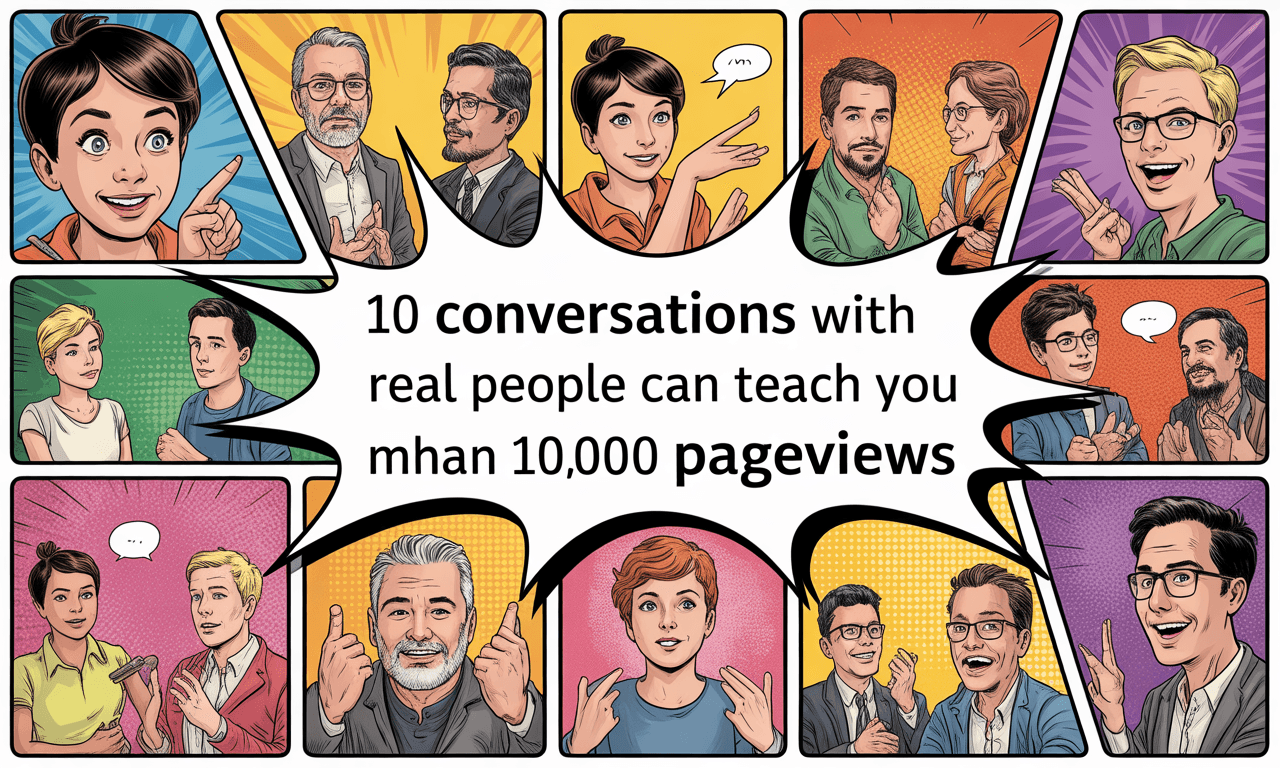
You’ve built something real, maybe it’s a landing page, a barebones MVP, or just an idea you’re itching to prove. You’re close. But now there’s a tension: you need to move from theory to people. From “what if this works” to “this works for someone real.” This is where 10 Conversations with Real People come into play.
This is the moment many first-time founders stumble. You wonder: “Who will care? Who will pay? Is this really a problem worth solving?” You feel uncertain, exposed, even a little embarrassed about making mistakes. I’ve been there, and that’s exactly why I’m writing this.
Because if you want to build a business that lasts, you need to stop hiding behind screens. You need to talk to real people. Not just “target segments” or “user personas,” but actual humans who struggle with the problem you want to solve. Everything becomes sharper, clearer, faster once you do that, especially through 10 Conversations with Real People.
In this post, I’ll walk you through why this step matters, how to do it well (without being creepy or salesy), and exactly what to do this week. Let’s turn your progress into traction.
Engaging in 10 Conversations with Real People can significantly enhance your understanding of the market.
Why Conversations Beat Growth Hacks (Especially Early On)
1. You validate truth, not assumptions
Most go-to-market mistakes come from skipping this step. Founders build based on what they think customers want and then wonder why it doesn’t land. According to Mercury’s founder-led GTM guide, the most common mistake isn’t picking the wrong channel; it’s failing to validate sufficiently via real customer conversations.
When you speak with someone who actually has the problem, you discover the nuance: the language they use, the trade-offs they accept, the workarounds they already built. You get insight you can’t glean from surveys or logic.
2. You start building your initial relationships
Your first customers are not anonymous users; they’re human connections. Every conversation is an opportunity to build trust, to plant a seed. Some of those people might become your first paying customers, refer you, or even become early evangelists.
3. You get powerful stories, testimonials & social proof
When you help one person, their experience becomes your story. You will quote their feedback, tell their journey, use their testimonial. It converts better than any fabricated “we solved this problem for someone” marketing line.
4. You build founder empathy & confidence
You start to see the problem from someone else’s eyes. You stop designing in a bubble. Also: your confidence rises when someone says, “Yes, this resonates.” That internal feedback loop is fuel.
5. You’re in founder mode, hands on
Paul Graham talks about “founder mode” the posture where founders stay deeply connected to the front lines (customers, product, feedback) rather than distancing themselves early.
In that mode, you sense shifts early, fix things quickly, and stay grounded in reality. As companies scale, many founders drift away; but in the early days, you want the founder’s hands on the wheel.
The One-to-One Strategy: How to Do It Right (Not Cringe or Salesy)
You already have the structure of this in your notes. Here’s a refined version of your approach, with tactical nuance and guardrails.
Step 0: Pick “who” before “how many”
Define your ideal conversation partner. Don’t say “small business owners” say “independent fitness coaches in London making £30 to 50K annually,” or “freelance copywriters in New York who’ve just started selling digital products,” or “early-stage SaaS founders in Berlin with fewer than 10 paying customers.” The more specific you are, the sharper your outreach becomes. When you know exactly who you’re targeting, you immediately know where to find them and how to speak their language.
Because when you know who, you know exactly where to find them and how to speak to them.
Step 1: Engage publicly before messaging privately
Don’t jump into DMs out of the blue. First, become a visible presence in the communities where these people already hang out: Facebook groups, LinkedIn, Twitter threads, Slack/Discord, niche forums.
- Look for posts where someone is complaining, venting, asking for help with the problem you want to solve.
- Leave thoughtful, helpful comments. Don’t pitch. Add value, a question, a resource, a short experience.
- Over time, your name becomes familiar. You build legitimacy before asking for time.
Step 2: Identify about 10 conversation targets
Go through your group or forum and pick 10 people who are:
- Actively posting about the problem you want to solve
- Seem open to engagement (they respond to comments, ask questions)
- Align with your ideal profile (geography, industry, stage)
You may find more, but working with 10 is manageable in a week.
Step 3: Craft your outreach message (short, genuine, zero selling)
Here’s a simple formula:
Hi [Name],
I saw your post about [problem]. I’ve been digging into the same challenge for [your context]. I’d love to learn more about how you think about it, if you’re open, would you be okay with a 15-minute chat? No pitch, just learning.
Tips:
- In the first outreach, don’t sell or pitch, emphasize learning or curiosity.
- Keep it 2–3 sentences. People are busy.
- Make scheduling easy (attach a Calendly link, or propose 2–3 time slots).
- If you don’t hear back in a day or two, send a brief follow-up. Myk Pono’s advice: two follow-ups max (3 messages total) is a good sweet spot.
Step 4: Conduct the chat, listen far more than you speak
Here’s a conversation guide:
Opening (2 min):
- Thank them.
- Reiterate you’re not selling.
- Ask permission: “I have a few questions; will you help me understand your thinking?”
Core (10 min):
Ask open-ended, empathic questions:
- “How long have you been experiencing [problem]?”
- “What have you tried so far?”
- “What’s the hardest part of dealing with it?”
- “If this problem were solved, what would change for you?”
- “On a scale of 1–10, how painful is it right now?”
- “Where do you go to look for solutions or tools now?”
- “If you started fresh, what would you do differently?”
As they answer, dig deeper: ask “why” or “tell me more” where helpful.
If you have a related story from your experience, share it briefly, it builds connection, not distance.
Closing (3 min):
- Ask if you can follow up with clarifying questions later.
- Ask them to suggest one more person you should talk to (this is gold).
- Express gratitude sincerely.
- Optionally, offer something small in return: a summary of your findings later, or a useful resource you’ve discovered.
Step 5: Synthesize insights & act on them
After every conversation, immediately (within an hour) write a brief “post-call note” covering:
- Key pains they expressed
- The language/phrases they used
- Surprises or contradictions
- Ideas the person has to solve it
- Any referral names or leads
Once you have 3–5 conversations, you’ll start seeing patterns. Use those patterns to refine your messaging, your positioning, even whether the problem you’re solving is sharply defined or needs tweaking.
Overcoming the Fear of Reaching Out
I get it. It’s uncomfortable to message strangers. You imagine silence. Or worse, rejection.
Here’s how I’ve reframed this fear over time (and continue to):
- Ask: What’s the worst that can happen? Usually: no response. That’s it.
- The upside? You might meet your first customer. Or someone whose feedback shifts your whole direction.
- Most people are pleasantly surprised when someone asks about their problem. It flatters them, shows you see them.
- Rejection sometimes gives you clarity: if someone isn’t willing to talk, maybe they don’t feel the pain.
- Scale the bravery: start with easier communities (smaller, more niche) before you target big names.
- Use templates + scripts so the “first message” isn’t blank. You just adapt.
Every time you override the hesitation, you build psychological muscle. The person who doesn’t respond is not your customer, the ones who do might change your business.
This Week’s Mission: Reach Out to 10 People
To turn this into action, here’s your mini-workshop:
| Day | Task |
|---|---|
| Day 1 | Define your 1–2 ideal personas & list 2–3 communities they frequent. |
| Day 2 | Engage in existing threads, comment 3–5 times. |
| Day 3 | Shortlist 10 people to reach out to (from those communities). |
| Days 4–5 | Send your outreach messages (1–2 per day). |
| Days 6–7 | Conduct chats, take post-call notes, send follow-ups as needed. |
Your only goal: get at least 5 conversations by the end of the week. More is bonus.
What Happens After the Conversations
- You’ll refine your messaging & positioning
- You may uncover disqualifiers you didn’t know
- You’ll have testimonials, quotes, stories to use publicly
- You’ll gain momentum, you’ll feel on the path
- You may even sign your first paying pilot or pilot user
Then you repeat. Talk to 10 more. Then 20. The flywheel spins faster.
Conclusion
You’ve already taken the hardest step, starting. Now the most powerful progress happens when you bring your idea into conversation with real people.
The One-to-One Strategy I laid out won’t feel sexy or viral. But it will make your foundation strong. It will teach you realities your assumptions can’t. And it will connect you, to your first customers, your first advocates, your first feedback loops.
So here’s your challenge: reach out to 10 people this week. Don’t overthink. Just do. Learn. Iterate. Tell me how it goes, I want to hear your stories.